
Postcard from Chongqing
Reflections from my fourth trip to China

“Prepare yourselves. We’re about to enter the Matrix. Are you ready to take the red pill?” Our guide, Kojima, handed each of us a mango-flavored Peelerz gummy candy. We accepted, newly initiated, and crossed the threshold of the Baixiangju Mansions, six 24-story buildings without a single elevator. The first hall of small shops ended at a door sign that told us we were somehow on the 12th floor now. When we stepped into the outside passageway, the complex revealed a steep drop down to the many floors of housing beneath us.
Kojima warned us that the Sentinel drone would catch us if we stood out in the open with our mouths gaping for too long, so we moved on to the next hall. Yet the next doors that Kojima pointed out revealed that we had somehow been transported onto the 15th, and then the 16th, floors, as if we’re stepping through portals. Although we had ascended a handful of stairs along the way, the math wasn’t adding up.
With a curling-up smile, Kojima beckoned us around the corner, which contained a crisscrossing, scissor-style staircase. They’re meant to save space and increase throughput, though Kojima also noted that their layout allows one to shoot a perfectly looping video of someone running up and down the stairs forever. Or, he grinned, they’re the perfect place for Neo to spot the same black cat twice.

We took the stairs down and emerged onto a lower platform, where we could see the entire residential complex from a distance at last. Back in the 1990s, when Baixiangju was built, elevators were very expensive, and the city required buildings taller than eight stories to have elevators. Its developers got around this requirement by exploiting its slope and building a network of cascading terraces that created several “ground floors.”
Buildings like Baixiangju from the 80s and 90s can be found all over the city. Over the past three days, the visual illusions of Chongqing’s architecture and the ease with which its residents navigate them repeatedly surprised me. In a few steps, a bustling plaza surrounded by temples morphed into the roof of the 22-story Kuixing Building, an active hospital. A woman sipped calmly from her cup of tea as a Line 2 metro train hurtled past her, coming to a stop inside a 19-story residential building. As I nervously inched forward and back, peeking over the walkways of the Linhua Road Residential Complex to the ground far below, the old man sitting on an upside-down bucket gave me a toothy grin, proud of the reaction his home provoked in others.
This full-day tour in Chongqing was the final stop of my fourth trip to China. On previous trips, my experience of the country had mainly been overwhelming: crowds of people pushing and noise shooting out from every direction. National parks felt overly restrictive, confined to strict routes, while tourist “heritage streets” were overly commercialized, with businesses copied and pasted block after block.
Yes, these issues still exist, but on this trip, I’ve started to separate the signal from the noise. I can understand more of the characters on street signs, schedule manicures for my entire family on Dianping, and even make it through several personal training sessions at the women’s weightlifting gym that I found next to my grandpa’s apartment in Kunming. Returning to Shanghai now felt like a homecoming, and showing Nick China for the first time went smoothly.
In these cities, thanks to the impactful week that I spent in Shanghai this summer, I sought refuge in unfamiliar underground music and green spaces. In Hong Kong, after a night out with friends that involved a party dinner accented by a smoke machine, the opening of a Sapporo beer with a chopstick (followed by the successful pouring of said beer down a precisely arranged line of 15 razor clams into a friend’s mouth), and bar hopping in LKF, Nick and I slipped away to more silent streets to catch a late set at minh club. We sat in an alcove across from the two DJs, taking in their tiny hats and the little smiles they put on when they hit a solid transition, our heads nodding with the bobbing of the crowd until we were ready for sleep.
That same afternoon, I had decided at the last minute to take a solo hike up Victoria Peak. I rode the longest-in-the-world Mid-Levels escalator system as far up as it could take me, then, with the help of very loud music, stair-machined myself to the top. When I turned onto the flat Lugard Road, I encountered a view so beautiful, so majestically peaceful, that I had to take my headphones off and scrap my plans to turn around early.
In Zhangjiajie, the national park that inspired James Cameron’s Avatar, peak-month crowds can cause hour-long waits for the national park’s multimodal transit system of cable cars, buses, trains, and carts. My mom and I were lucky that only a few people were around in December; we had a relatively seamless experience (besides the monkey that snatched my mom’s snack out of her hand when she wasn’t paying attention). On our last two stops in the park, we were the only two people to get off the bus. At the Arranging Battles Platform (点将台), although I was too scared to get close to the edge, I found comfort in the tiny temple that perched above the trees in the distance and the numerous, uniquely-shaped figures that rose from the mist and met me at eye-level.


I felt a deep connection to nature in these moments, but exceptionally so in my walks through Chongqing. Watching people move through the newly opened Eling Cliffside Footbridge and meandering through the cliffside Zengjiayan path amongst the trees, it was as if we all turned into monkeys moving gracefully across a canopy. As a line of commuters diligently worked our way up Fotuguan Park’s never-ending series of stairs from the Fotuguan metro stop, we shrank into ants.
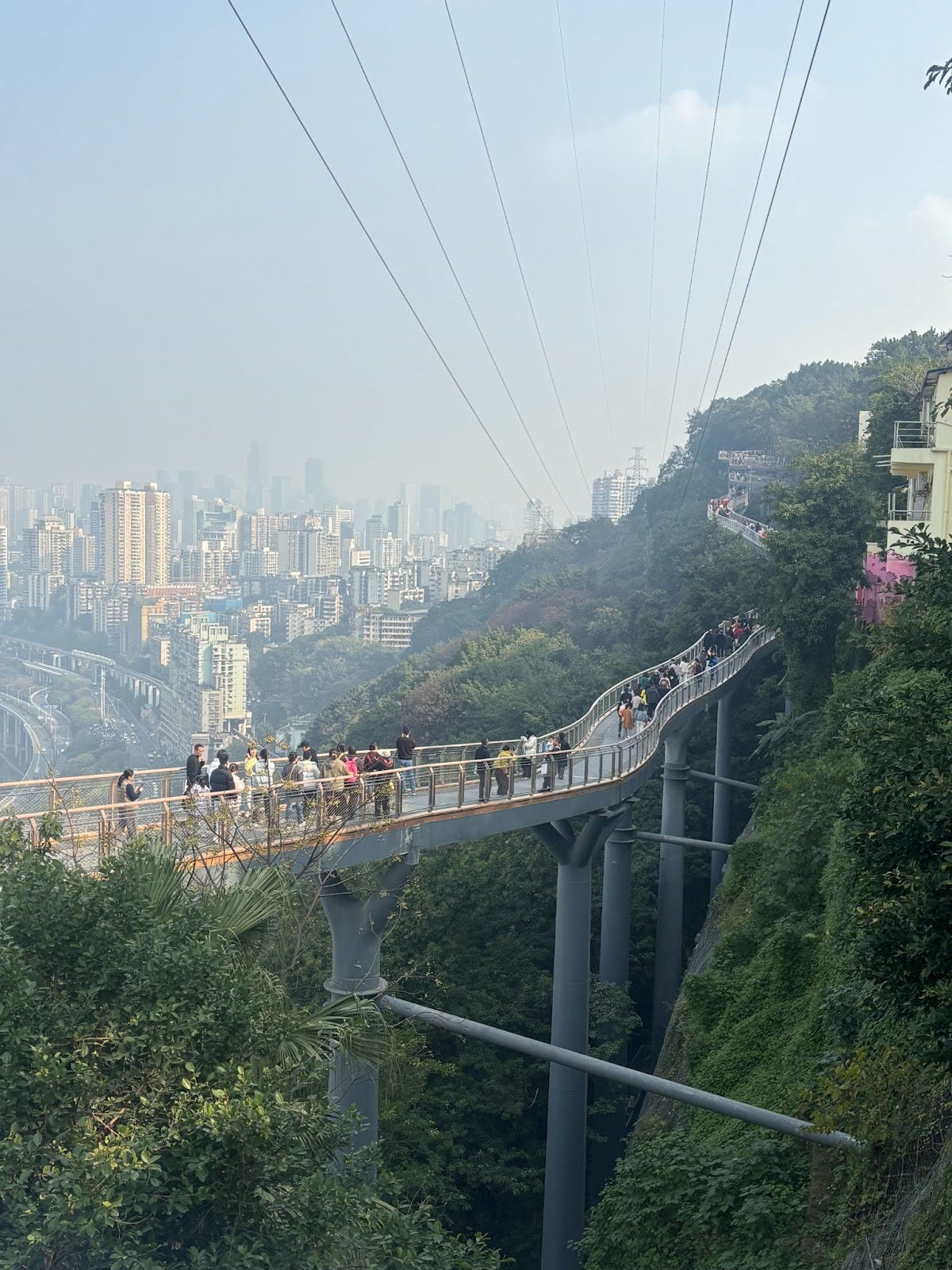
Chongqing’s flirtation with scale helped me appreciate how small I am. I was lucky to catch the city’s once-weekly 10,000+ drone show as it formed a brief solar system model in the sky, beckoning me toward Chaotianmen Square’s waterfront, where I took a curious set of stairs down to find a tunnel stinking with exhaust. This was where all the road’s traffic had been cleverly hidden away! I continued on, following some people outside, where I found a waterfront pathway, in which towering concrete pillars, shrouded in greenery, held the rest of the city in balance over our heads. Down here, I first saw the city’s wall foundations and the root systems of its ancient trees. It’s incredible to think that this base manages to hold together such a thriving, complex, mountainous city.


As our tour came to a close over a barbecue dinner in Xiahao Lane (a historic, cultural block that, rather than being a mere tourist checkpoint, is actually thriving), Kojima mused that Chongqing doesn’t entirely fit its image: “To be steampunk, you need to have steam.” He says that China wants Chongqing’s city center to be pristine, to show it off, and has consequently pushed its steam-producing industries out.
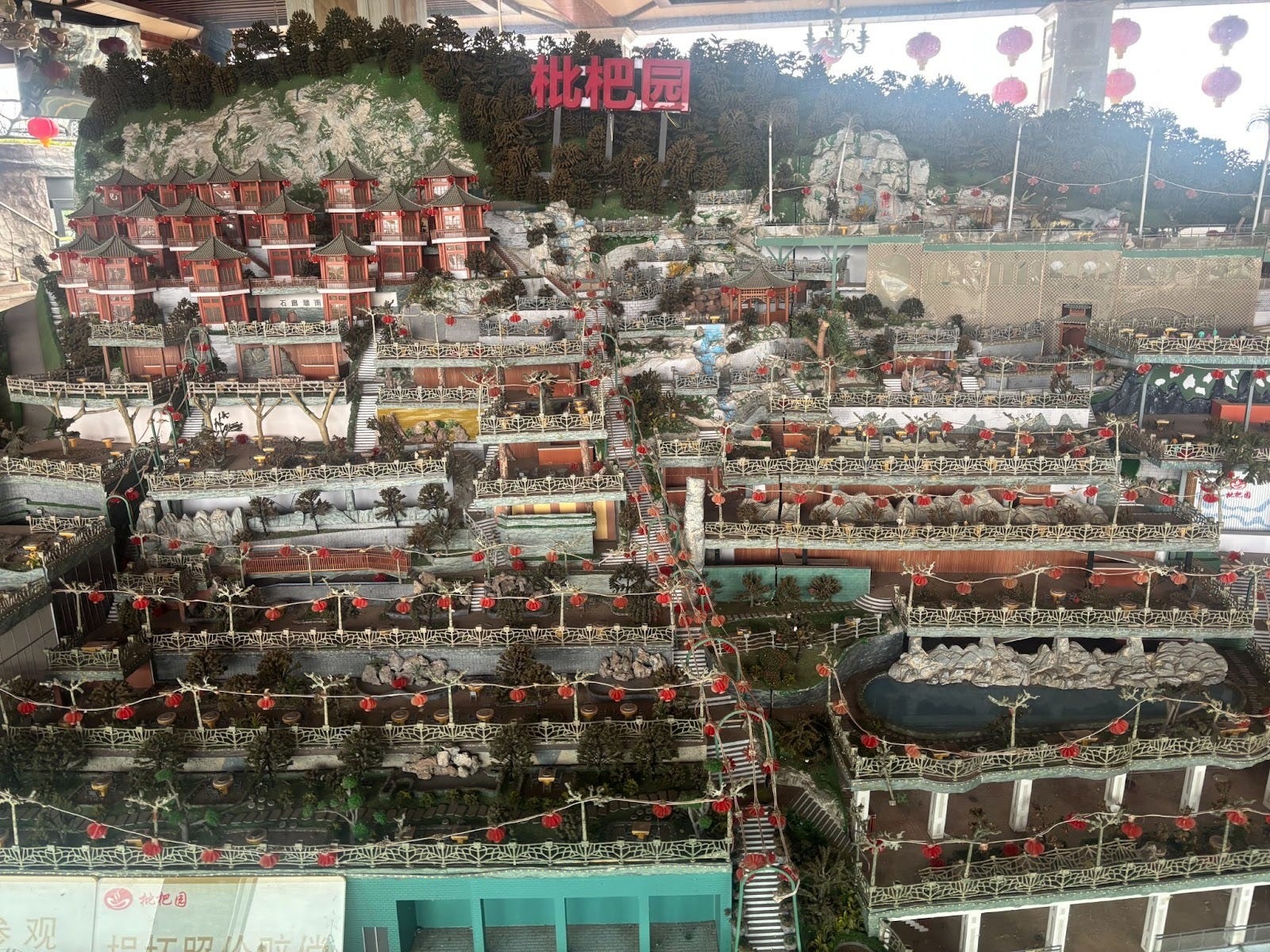
In Chongqing, what happens to places when they’re no longer in trend? Throughout the trip, I witnessed areas in different phases of the trend cycle. When I visited TESTBED2, a former printing factory turned “creative hub,” I struggled to find any trace of culture or art. It felt hollowed out, optimized for social media photos. Even worse, the manhole next to its food hall periodically released the smell of sewage. That evening, my family and I ate dinner at a popular mall restaurant that seemed to be the only business still open. The upper floors were fading into darkness while new malls rose from its ashes. During the tour, we had driven past several abandoned, decaying buildings in the mountains that had once been popular spots for night walks. We snapped pictures during a brief stop at the Pipa Yuan complex, which holds the Guinness World Record for the world’s largest hotpot restaurant. Kojima told us it was created solely to win the Guinness World Record. While it seated 5,851 people, nobody was dining when we walked through the grounds.
Over these trips to China, I’ve seen firsthand how its engineering state builds quickly enough to keep up a dazzling spectacle, directing the trend cycle to new malls and heritage streets–places to shop, consume, and post–distracting from what’s happening in the background: the decay and demolition of what has gone out of style. As China grapples with a declining economy, youth unemployment, and rising inequality, this pattern is unsustainable. Furthermore, as Dan Wang writes in Breakneck, its overbearing government censorship makes it challenging for authenticity, creativity, and culture to thrive. For example, I’ve heard from Chinese friends how numerous queer underground music venues in Chengdu and Shanghai have closed since the pandemic, and that the country has intensified crackdowns on online fanfiction writers.
This trend is foreboding, and I believe that China must try to be open to these underground cultures to continue to thrive, to cultivate the moments of awe, inner stillness, and connection that I experienced on this trip in more of its public spaces: parks, cultural venues, and beyond. These spaces inject a bit of wildness and disorder into the Chinese cityscape. They are glimpses of magic, opportunities to convene with nature, hints of paths yet unexplored, and peeks of public art tucked into the bushes. As we leave dinner to start our journey back to the hotel, the warm orange sign that hangs above the manmade waterfall in the middle of Xiahao Lane makes me pause: 什么是梦? 現實升起来以便配得上幻想。What is a dream but our reality rising to fit our fantasies?
Although I’m coming home tomorrow, I’m excited to bring the dream I discovered in Chongqing back with me, as my classmates and I envision how to build back America’s cities.
that was a good read!!! thanks for sharing <3
- french naomi